
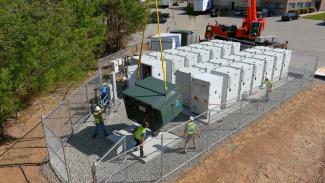
Energy storage is a critical piece of Rhode Island's clean energy strategy. Battery systems store electricity when it is abundant and inexpensive and discharge it when demand is high, reducing costs for ratepayers, cutting emissions from fossil-fueled peaking power plants, and strengthening the resilience of our electric grid.
Rhode Island has set ambitious targets for energy storage deployment. The 2024 Energy Storage Systems Act (R.I. Gen. Laws § 39-26.10) established a statewide goal of 90 MW of energy storage capacity by 2026, with longer-term targets extending through 2033. Meeting these goals requires coordinated investment from homeowners, businesses, utilities, and state government.
The Office of Energy Resources (OER) supports energy storage adoption through direct financial incentives, program coordination, and public education. Whether you are a homeowner considering a battery to pair with your solar panels, a business looking to reduce demand charges, or a developer planning a larger commercial installation, the resources below can help you get started.
Energy storage is any technology that stores energy produced at one time for use at another. A rechargeable battery is the most familiar example: it stores electrical energy in chemical components and releases it on demand. Battery energy storage systems for homes and businesses work on the same principle at a larger scale, charging from the grid or from solar panels and discharging when the energy is needed.
A home or business battery system typically includes one or more battery modules, an inverter (which converts between DC battery power and AC household power), and a control system that manages when the battery charges and discharges. The system connects to your building's electrical panel and, in most configurations, can automatically switch to battery power during a grid outage.
Rhode Island's clean energy transition depends on deploying more renewable generation, but solar and wind are intermittent — they produce power based on weather conditions, not necessarily when electricity is needed most. Energy storage fills that gap. It absorbs excess renewable generation during the day and releases it during evening peaks, reducing the need for fossil-fueled peaker plants and helping the state meet the emission reduction mandates of the 2021 Act on Climate.
The 2024 Energy Storage Systems Act set a target of 90 MW of storage capacity by 2026, recognizing storage as an essential grid resource. Every battery system installed in Rhode Island contributes to this statewide goal.
Lower energy costs - Battery systems can store electricity during low-cost periods and discharge during expensive peak hours, reducing your electric bill. On the supply side, storage captures energy when wholesale prices are low and discharges when prices are high. When aggregated across many customers, storage also lowers the systemwide costs that all ratepayers share. Customers can earn additional income through demand response programs like ConnectedSolutions.
Backup power and resilience - During a power outage, a battery system can keep critical loads running — lights, refrigerators, medical equipment, and communications. Homes and businesses with solar-plus-storage can operate as independent microgrids until the grid is restored.
Reduced emissions - By displacing natural gas "peaker" plants that run only during high-demand hours, battery storage helps Rhode Island lower its greenhouse gas emissions and meet the mandates of the 2021 Act on Climate. Storage also enhances community resilience during extreme weather events by providing local backup power.
Grid reliability - Energy storage responds to grid needs in milliseconds, providing fast-acting capacity that helps utilities manage sudden changes in supply and demand. This reduces the need for expensive infrastructure upgrades to poles, wires, and substations, and lowers the systemwide costs that drive electric rates.
Support for renewable energy - Solar panels produce electricity during the day, but demand often peaks in the evening. Storage bridges that gap, making renewable energy available when it is needed most and reducing the amount of clean energy that goes to waste.
While battery systems are the most common technology for behind-the-meter applications, energy storage also includes mechanical systems (such as pumped hydroelectric and flywheels), thermal systems (such as ice storage and molten salt), and chemical systems (such as hydrogen). Each technology has different characteristics suited to different applications. For residential and commercial use in Rhode Island, lithium-ion battery systems are the dominant and most commercially mature technology.
| Program | Description |
|---|---|
| Energy Storage Rebates | OER rebates of up to $8,000 (residential) or $45,500 (commercial) for new battery installations. Income-eligible customers may qualify for up to $16,000. |
| ConnectedSolutions | Rhode Island Energy's demand response program that pays battery owners to discharge during peak grid events. |
| 0% Heat Loan Financing | Zero-interest financing for income-eligible customers installing battery storage. |
Energy storage system (ESS): An umbrella term for any technology that stores and returns energy.
Battery energy storage system (BESS): A storage system that uses battery chemistry to store electrical energy. Sometimes shortened to "battery system" in residential and commercial contexts.
Energy storage facility: The complete installation, including batteries, inverters, HVAC systems, fire suppression, battery management systems, and site preparation. This term is typically used for utility-scale projects.
kW (kilowatt): A measure of power — the rate of energy output at any given moment.
kWh (kilowatt-hour): A measure of energy — the total amount of power delivered over time. A battery rated at 5 kW / 13.5 kWh can deliver up to 5 kW of power and stores 13.5 kWh of energy, enough to sustain approximately 2.7 hours of output at full power.
2024 Energy Storage Systems Act (R.I. Gen. Laws § 39-26.10) — Establishes statewide energy storage deployment targets: 90 MW by 2026, with subsequent targets through 2033.
2021 Act on Climate (R.I. Gen. Laws § 42-6.2) — Mandates economy-wide greenhouse gas emission reductions, including 45% below 1990 levels by 2030 and net-zero by 2050.
Regional Greenhouse Gas Initiative (RGGI) — The ESR Program is funded by RGGI auction proceeds, which Rhode Island law directs toward cost-effective investments that reduce long-term consumer energy demands and costs.